
Case Study: 4VOD — Multi-Channel Playout and Content Distribution with SRT Contribution
4VOD, a media, telecommunication, and content distribution service provider since 2009, needed to replace expensive satellite infrastructure and leased IP lines with a more flexible and cost-effective solution for distributing multiple TV channels across Europe. The company required secure, reliable IP contribution to deliver playout services to various destinations while maintaining broadcast-grade quality.
About 4VOD
4VOD is a media, telecommunication, and content distribution service company operating since 2009. During that time, the company has conducted projects related to TV channel management services, TV applications, catchup TV, live channel streaming, OTT services, and live TV streaming services.
Currently, 4VOD is mostly focused on playout and content distribution for its European clients. Among channels operated by 4VOD are Sportklub, Fightklub, Golf Channel Polska, Romance TV, Motowizja, Studiomed, and many others.
Challenge
4VOD handles content distribution and playout services for many different channels to various locations across Europe, including cities like Paris, London, Frankfurt, Berlin, Warsaw, Moscow, Bucharest, and Budapest. All these destinations were connected to the 4VOD network using satellite infrastructure or leased IP lines.
The company wanted to:
- Replace expensive satellite contribution and leased IP lines with a more cost-effective solution
- Implement a more flexible and less demanding delivery solution
- Ensure security and reliability of video contribution connections
- Acquire channels from international broadcasters and deliver them to cable operators and TV platforms worldwide
- Maintain broadcast-quality video delivery without transcoding
- Enable easy setup and maintenance for operations teams
Implementation
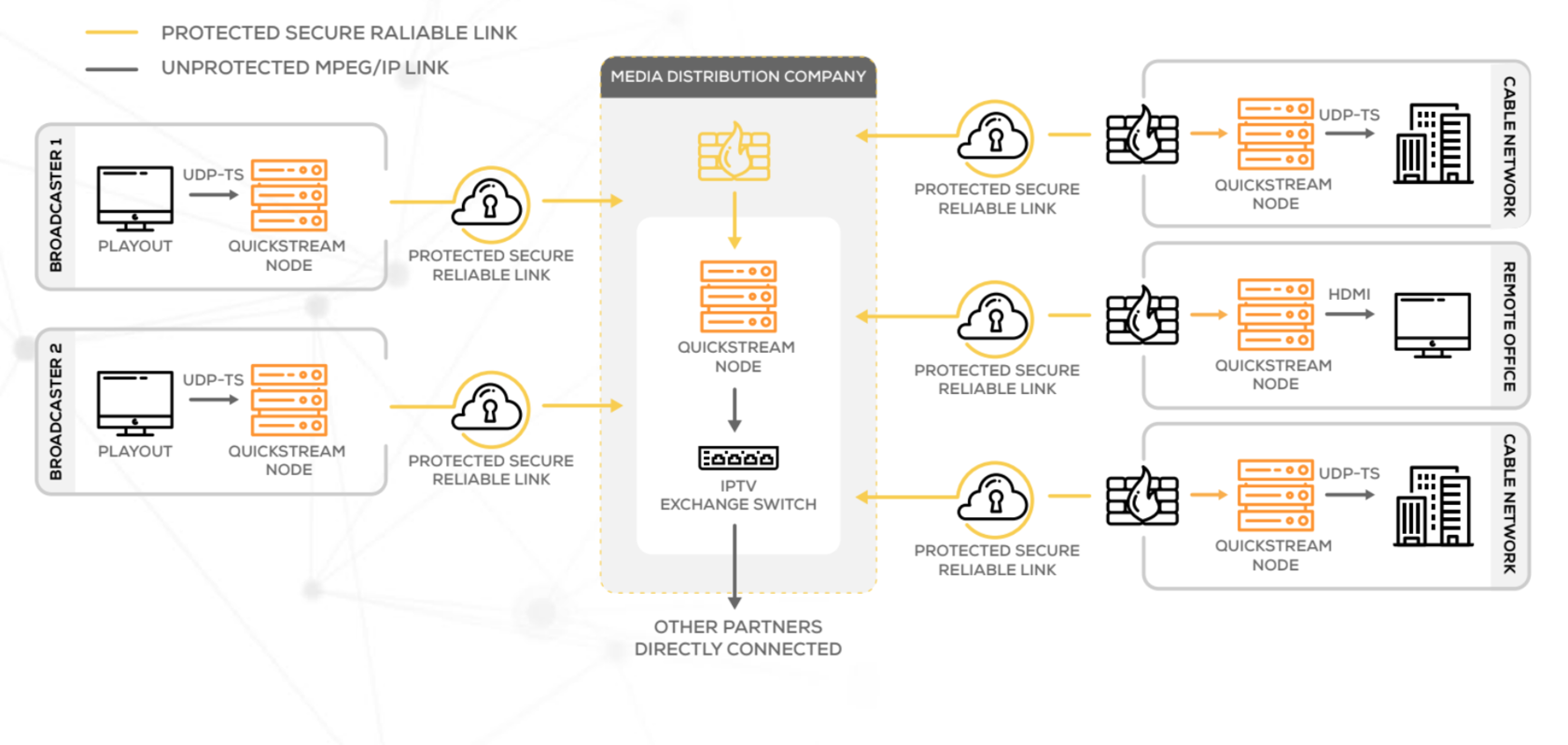
4VOD implemented Quickstream Node as a TV channel delivery gateway in the third quarter of 2019. The deployment included:
- SRT contribution over IP: Replaced satellite infrastructure and leased IP lines with SRT contribution over public Internet
- Multi-channel distribution: Deployed Quickstream Node for distributing multiple channels to various European destinations
- International video acquisition: Used Quickstream software to acquire channels from international broadcasters
- Cable operator delivery: Delivered channels to cable operators and TV platforms around the world
- Primary and backup feeds: Implemented Quickstream for primary distribution and backup paths
- Preview functionality: Used Quickstream for preview feeds in addition to primary distribution
- Quickstream Cloud testing: Began testing Quickstream Cloud for centralized monitoring and management
Results
The solution proved to be stable, easy to set up, and secure. 4VOD successfully replaced all other transmission methods in its connections with Quickstream.
Key outcomes:
- Successful migration: Replaced satellite infrastructure and leased IP lines with IP-based video contribution
- Stable broadcast-quality delivery: Reliable distribution of multiple channels to European destinations
- International video distribution: Successful acquisition and delivery of channels from international broadcasters to cable operators and TV platforms worldwide
- Cost savings: Significant reduction in costs compared to satellite contribution and leased IP lines
- Easy setup and maintenance: User-friendly interface for operations teams
- Secure video transmission: Industry-standard encryption for secure video contribution
- Flexible deployment: Quickstream used for primary distribution, backup, and preview feeds
- Cloud platform testing: Early adoption of Quickstream Cloud for enhanced monitoring and management capabilities
4VOD considers implementing the cloud-based platform in its workflow to further enhance operational efficiency and centralized management.
Why 4VOD chose Quickstream
- SRT contribution protocol: Industry-standard SRT protocol for reliable IP video contribution over public Internet
- Works over Internet connections: Secure video over IP using public Internet infrastructure, eliminating need for leased lines
- Packet loss and jitter resistant: Robust error handling for reliable broadcast video delivery
- Quick and easy to install and maintain: User-friendly interface for operations teams
- Works on any PC hardware: Including virtualized environments, no proprietary appliances required
- Broadcast-quality video: Ability to work in broadcast quality without transcoding
- Multi-platform support: Supports Windows and Linux operating systems
- Secure video transmission: Encrypted with industry-standard AES-128/256 encryption
- Ultra-low latency: Below 200 ms latency suitable for live broadcast operations
- Point-to-point video streaming: Direct SRT streaming connections
- Easy firewall traversal: No IT support required for network configuration
- Cost savings: Saves up to 80% on costs of channel delivery compared to leased lines and satellite connections
- Easy setup: Installation without costly hardware requirements
- Flexible licensing: Short-term options available
- Easy migration: Simple transition from outdated satellite infrastructure and leased IP lines
- Direct integration: Installation on playout and production systems
- Cloud management: Integration with Quickstream Cloud for centralized monitoring and management (optional)
- Network flexibility: Designed for unmanaged IP networks (Internet) and LAN
At a glance
- Use case: Multi-channel playout and content distribution across Europe, international video acquisition and delivery
- Technology: SRT contribution over public Internet, Quickstream Node for broadcast-grade video over IP, Quickstream Cloud (testing)
- Destinations: Paris, London, Frankfurt, Berlin, Warsaw, Moscow, Bucharest, Budapest, and other European cities
- Channels: Sportklub, Fightklub, Golf Channel Polska, Romance TV, Motowizja, Studiomed, and many others
- Outcomes: Successful replacement of satellite and leased IP lines, stable broadcast-quality delivery, significant cost savings, easy maintenance, early adoption of cloud platform


